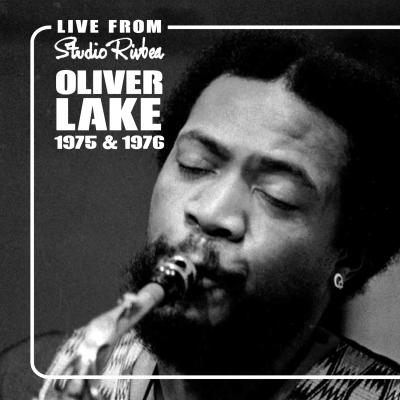
Featuring:
| 1. Clarity 2 / Six Beats Out |
9:17 |
| 2. A Space Rontoto |
7:51 |
| 3. Re-Cre-Ate |
8:54 |
| 4. Lodius |
7:35 |
| 5. Rue Roger | 23:03 |
| 6. Rite-ing |
6:02 |
| 7. Trailway Shake |
10:19 |
John Sharpe - Point of Departure
Another astonishing find from the late Sam Rivers’ Rivbea Archives unites two loft era dates by reedman Oliver Lake that capture a pivotal time of accelerated growth for Lake, fresh back in New York after a sojourn in Paris. The pieces recorded during the 1976 Rivbea summer festival constitute the main reason for excitement, rounding out the two tunes from the same set (including one under guitarist Michael Gregory Jackson’s name) already issued on the legendary Wildflowers (Douglas, 1977) survey of the NYC loft scene. Also of interest, although less satisfying both musically and sonically, are the pieces from an earlier Rivbea Festival in 1975. However, the sleeve credits for the two sets seem awry. More on that later.
Lake revisits much of the repertoire on his contemporaneous releases Holding Together (Black Saint, 1976), his duo disc with trombonist Joseph Bowie (Sackville, 1976), Life Dance Of Is (Arista Novus, 1978), and Shine! (Arista Novus, 1979). But the live versions reveal much of what follows after the opening themes to be open improvisation, sometimes markedly dissimilar to later iterations, although nonetheless often consistent in maintaining the initial mood. As in his writing, Lake’s lines frequently rotate between the intervallic leaps of his inspiration Eric Dolphy and tender slightly bittersweet melodies. On alto, he moves with a snaking urgency, while his flute playing veers bucolic.
For the 1976 occasion, Lake called on a crew of close associates – bassist Fred Hopkins, drummer Phillip Wilson, both familiar from the AACM, and the 22-year-old guitarist Michael Gregory Jackson who he recruited in New Haven. In ensemble music, Jackson (an acknowledged influence on both Bill Frisell and Pat Metheny) stands out for his expansive style which navigates between folky song-inflected picking, volume pedal swells, Hendrix-inspired snarl, and feedback. Hopkins too is a revelation here, eschewing pulse to bring a super resonant tone to percussive rattlings as well as bowed slashes and assertive pizzicato. Wilson avoids steady meter, instead commenting, coloring, accenting as part of the ongoing interaction.
Lake’s themes beget untethered interplay notable for its use of space and its restraint, offering a stark contrast to the fire music tropes often equated with the loft community. “Six Beats Out” waxes tranquil and melodic before unfurling into divergent drifting strands underpinned by Wilson’s intermittent clatter, by turns spacious and subject to sudden spurts. “A Space Rotonto” mixes raw-boned phrases with long tones, before choppy free-floating bass and drums take hold, with Hopkins’ sawing out front, preceding acerbic dialogue between alto and guitar.
On the 1975 performance, Jackson again complements the front line, joined by Hopkins on bass (although only on the first two selections, contra the sleeve credits), while Jerome Cooper, best known for his tenure in the Revolutionary Ensemble, occupies the drum stool. A soprano and guitar unison positions “Re-Cre-Ate” on a serene pathway, from which it quickly digresses, the improvisation becoming explosive and fragmentary. “Lodius” begins more angular, but constantly dissolves and reforms thereafter. In their commitment to group interaction, both cuts match the excellence of the 1976 Wildflowers date. The drummer in fact plays much more akin to Wilson, than on the remaining pieces.
The sound and tenor of the last three tracks from 1975 seem to originate from a different sound source, carrying somewhat more distortion, with a WKCR radio station ID intruding at one point. In terms of instrumentation, they also differ. “Rite-ing” presents Lake unaccompanied, alternately gnarly and lyrical. Trumpeter Baikida Carroll appears on the other two (contra the sleeve, where he is credited to one track only), but notwithstanding Hopkins’ name among the personnel, there is no bass on these pieces, as confirmed at the close of the final “Trailway Shake,” where Lake introduces the band without mention of the bassist.
For much of its 23-minutes, “Rue Roger” erupts in a full-on blow out, raw and abrasive and by some measure the album’s least interesting stretch. The horns bicker over a drum tattoo, and Jackson when he enters shreds and wails. Lake’s switch to flute promises a brief respite, but Cooper’s active attack retains a cymbal pulse even here. Carroll’s wah-wahed trumpet fleetingly features on “Trailway Shake”, but again Cooper’s martial bursts and drum rolls fill out the spaces which lend depth and subtlety to the exchanges elsewhere.
Still in spite of the drawbacks, the first four cuts in a generous 73-minute program account for much of the set’s musical value. It is a revealing archival snapshot of a wobbly and undervalued period, in which creativity blossomed away from the commercial imperatives of clubs and bars, and affirms Lake as one of the era’s most probing and durable voices.