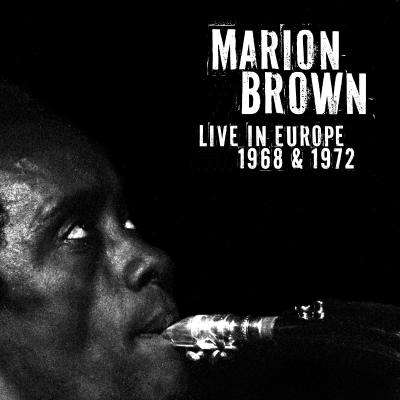
Featuring: Marion Brown
| 1. Current Events |
12:08 |
| 2. Epiphanie |
10:03 |
| 3. 61 to Erie Basin |
10:37 |
| 4. Djinji’s Corner |
22:07 |
| 5. Afternoon of a Georgia Faun | 17:24 |
Chris Robinson - Point of Departure
In August of 1967, Marion Brown moved to Paris, which became his home base for the next two years. After freelancing across Europe those first months and recording Porto Novo in December with Maarten Van Regeteren Altena and Han Bennink, Brown put together a quartet in January of 1968 with Gunter Hampel on vibes, Barre Phillips on bass, and Steve McCall on drums. That March the quartet made its debut recordings at Maison de la Radio in Paris. The opener, Brown’s “Current Events” has a jumpy, twitchy theme that immediately gives way to a Brown solo that is charged with melodic invention. The time is more implied than played, and when he unleashes a rash of urgently expressed shrieks and bursts of harshly articulated notes, Hampel’s vibes ring over a supercharged rhythm section. The vibist dials the intensity down during his solo as Phillips accompanies with his bow. Phillips quiets things further before Brown comes back and the foursome turn up the heat. The theme of Hampel’s “Epiphanie” built around short, repeating phrases that could easily become hypnotic if the group dwelled on them at length. Brown repeats a healthy quote of “Rhapsody in Blue” while still in the middle of the head. Hampel takes the first solo, using the pedal to create a dreamscape of ringing tones. As before, Brown is the more strident partner to the relatively understated Hampel. The final of the three pieces heard here, Brown’s “61 to Erie Basin,” begins as a medium swing that goes out of time for Hampel and back in for Brown. Midway through the group seems to question the way forward for a few moments, but to their credit, they had only been together for a few months.
After his stay in Paris, Brown went back to the United States, where he worked with Wadada Leo Smith and taught at Bowdoin College in Maine. In the summer of 1972 Brown performed across Europe. That August he and McCall appeared at the Festival de Châteauvallon in Ollioules, France, where they played “Djinji’s Corner” and “Afternoon of a Georgia Faun.” Brown afficionados will recognize these titles as the two pieces that comprised Brown’s 1970 ECM album Afternoon of a Georgia Faun. The live version of “Djinji’s Corner” is quite different from that appearing on the LP. The composition calls for each musician to move to different stations and play a different instrument and theme at each. As a duo, Brown and McCall could not recreate the same diversity of colors and density of textures as the seven musicians heard on the LP; yet, over the twenty-two minutes, the pair move through a series of loose set pieces: subtone alto above barely audible shakers; pitched idiophone phrases that McCall moves aside with cymbals and drums; an arrested alto solo accompanied by kick drum and cymbals; percussion call and response, etc. The meditative sound world from “Djinji’s Corner” continues in “Faun,” which retains the narrative arc heard on the LP. Brown and McCall begin with quiet and delicate shakers and pitched percussion that sounds very much like the raindrops that Brown describes on the LP’s liner notes. The duo builds to the high point slowly, with stillness and space. Brown plays low wooden or bamboo flute tones while McCall expands from shakers and bells to drums and cymbals. Brown moves between alto and bells as McCall opens up on his kit. The apex comes, not with a flash or a bang, but with a restrained alto-drums duet that maintains the attention to nuance, subtlety, and form the piece requires. Although each composition’s form isn’t as clear in the duo context as they were on the LP, there’s a palpable air of experimentality that shrouds the performance in mystery.
In its entirety, the disc captures Brown at two points in the development of his compositional and instrumental voice, demonstrating how he used them in different contexts. The 1968 recordings show Brown at the beginning of his run of albums that featured the core of Hampel and McCall: Le Temps Fu, Gesprächsfetzen, and In Sommerhausen, while the duo set shows him at the transition between Afternoon of a Georgia Faun and Geechee Recollections and Sweet Earth Flying. Live in Europe, 1968 & 1972 might not be an ideal entre into Brown’s oeuvre, as he plays relatively little alto on the 1972 recordings, but for serious Brown fans, it is an illuminating and essential release.